

What Is The Registered Part Of An Fn Fnc
| FN FNC | |
|---|---|
 FNC rifle equipped with a bayonet. | |
| Type | Assault rifle |
| Place of origin | Kingdom of belgium |
| Service history | |
| In service | 1979–present |
| Used by | See Users |
| Wars | Aceh Insurgency Sri Lankan Civil War Tuareg rebellion (1990–1995) Somali Civil War War in Afghanistan Conflict in the Niger Delta 2007 Lebanon conflict Libyan Civil War Russo-Ukrainian War |
| Production history | |
| Designer | FN Herstal |
| Designed | 1975–1977 |
| Manufacturer | FN Herstal Carl Gustafs Stads Gevärsfaktori PT Pindad |
| Produced | 1979–2004 |
| Variants | Meet Variants |
| Specifications | |
| Mass | Rifle: 3.840 kg (8.47 lb) Carbine: 3.7 kg (8.2 lb) |
| Length | Rifle: 997 mm (39.iii in) stock extended / 766 mm (xxx.2 in) stock folded Carbine: 911 mm (35.9 in) stock extended / 667 mm (26.three in) stock folded |
| Butt length | Rifle: 449 mm (17.seven in) (rifle) Carbine: 363 mm (14.3 in) |
| Width | 70 mm (2.8 in) stock extended 75 mm (3.0 in) stock folded |
| Height | 238 mm (9.4 in) |
| | |
| Cartridge | 5.56×45mm NATO |
| Action | Gas-operated long-stroke piston, rotating bolt |
| Rate of burn down | Approx. 700 rounds/min |
| Muzzle velocity | M193: 965 m/due south (3,166 ft/south) SS109: 925 m/due south (3,034.viii ft/south) |
| Constructive firing range | 250–400 k sight adjustments |
| Maximum firing range | 450 k |
| Feed system | 30-circular detachable STANAG box mag (standard consequence) or other STANAG magazines |
| Sights | Rear flip aperture, front end mail service 513 mm (20.2 in) sight radius (standard rifle) |
The FNC (French: Fabrique Nationale Carabine) is a five.56×45mm NATO assault rifle adult past the Belgian arms manufacturer FN Herstal and introduced in the late 1970s.
Evolution [edit]
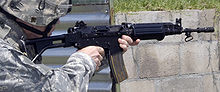
The FNC was developed between 1975–1977 for NATO standardization trials, as a less expensive alternative to the M16 burglarize.[1] [2] The rifle'south design is based on the FNC 76 prototype, which itself originated from the commercially unsuccessful FN CAL rifle.[1] This prototype was soon withdrawn from the NATO competition after performing poorly due to its rushed development.
The outset land to adopt the FNC was Indonesia, which purchased approximately 10,000 rifles in 1982 for its air strength. The Indonesian authorities later acquired a license to allow Indonesian firm PT Pindad to manufacture the rifle for all branches of the armed forces,[ane] equally the Pindad SS1 and Pindad SS2.
Trials for the Swedish Armed Forces were held betwixt 1981–1982, using updated prototypes that proved the utility and efficiency of the blueprint, impressing both the Swedish military and Belgian Army staff dorsum at home.[1] Sweden adopted a version of the FNC for domestic production in 1986, naming information technology the Ak v. Slightly modified, it remains the main service rifle of the Swedish Military.
The FNC was finally adopted by the Belgian Armed Forces in 1989, equally a service-wide replacement for the vii.62×51mm NATO FN FAL, after having been issued in small-scale numbers to airborne infantry units for several years.[1]
The rifle is besides used equally a service rifle by the armed forces of Tonga, a microstate in the Pacific Sea.
Design details [edit]
Operating mechanism [edit]

Diagram of gas-operated reloading.
The FNC is a selective fire weapon that uses a gas-operated long-stroke piston system and a rotating bolt locking mechanism equipped with two locking lugs that appoint corresponding recesses in the butt extension. The bolt is rotated and unlocked by the interaction of the bolt'due south cam pin with a camming guide contained in the commodities carrier. Overall, the machinery strongly resembles that of Kalashnikov rifles, simply adapted to more advanced design and product methods. The rear role of the cocking handle slot, cut in the upper receiver for the cocking handle, is covered by a spring-loaded cover which automatically opens past the handle when it goes back and automatically closes the opening when the cocking handle returns forward.[3]
Features [edit]

The spring extractor is located within the commodities head, the ejector is fixed and riveted to the within of the receiver housing. The FNC uses a two-position gas valve, a hammer-blazon firing mechanism and a trigger with a fire selector switch that is simultaneously the manual prophylactic, securing the weapon from accidental firing. The selector lever is located on the left side of the receiver and has iv settings: "S" - weapon rubber, "1" - single fire mode, "3" - 3-round flare-up, "A" - continuous (automated) burn.
The FNC's barrel features a flash suppressor that is also used to launch NATO standard 22mm rifle grenades (only the standard burglarize model has this capability). The gas block contains a gas valve setting that is used to isolate the gas system, providing an increased volume of propellant required to fire a rifle grenade. The sheet-metal gas valve switch when pulled upright, acts equally a Five-notch sight used for aiming the rifle grenades. The piston head and extension, likewise as the gas port block, barrel bore and sleeping accommodation, are hard-chrome plated to minimize the effects of propellant fouling.
The rifle feeds from 30-round steel magazines that are interchangeable with magazines from the American M16 rifle (STANAG 4179 compliant).[4] Afterwards the concluding round is fired, the bolt will remain airtight as at that place is no provision for an automatic commodities agree open. However, the commodities handle can exist manually worked to hold the bolt back. FNC magazines volition function in AR-15/M16-blazon rifles only the follower will not hold the bolt open up on the last round unless they accept been modified with an M16-type follower.[5]
The plastic-coated, lightweight alloy skeleton stock folds to the right side of the receiver. A fixed synthetic (polyamide) buttstock is also available.
The upper receiver is made from stamped steel, the lower receiver, along with magazine housing, is made from aluminum alloy.
Sights [edit]
The rifle has a flip-type L-shaped windage-adjustable rear sight with two apertures with settings for 250 and 400 grand, while the front sight mail service is adaptable for elevation. Optics such equally the Hensoldt 4× telescopic sight can be fastened with the use of a receiver-mounted adapter.
Accessories [edit]
Standard equipment supplied with the FNC includes a spike bayonet or a variant of the American M7 blade bayonet (with the use of a lug adapter) and a sling. The rifle can be deployed with a barrel mounted bipod and blank-firing adaptor.
Variants [edit]
The FNC is produced in two primary configurations: a standard rifle and short (carbine) length. The "Standard" Model 2000 rifle and the "Short" Model 7000 carbine are equipped with barrels with 6 correct-hand grooves and a 178 mm (one:7 in) rifling twist rate used to stabilize the longer and heavier Belgian SS109 bullet. The Model 0000 rifle and Model 6000 carbine utilize a slower 305 mm (1:12 in) twist charge per unit for the shorter and lighter American M193 bullet.
Fabrique Nationale also offers semi-automatic-only Constabulary Enforcement carbine versions:[ citation needed ] the Model 7030 with a 178 mm (1:7 in) rifling twist and the Model 6040 with a 305 mm (1:12 in) twist rate. These single-burn carbines feature a 410 mm (16.1 in) barrel and are also capable of firing rifle grenades and mounting a bayonet.
Sweden [edit]

The Ak 5C represents the latest Swedish evolution of the FNC.
The Swedish service rifle built past Bofors Ordnance (currently BAE Systems Bofors) is a modernized Model 2000 rifle without the iii-round burst fire control setting. It was accepted into service in 1986 as the Ak five later extensive trials and receiving several modifications and replaced the 7.62mm Ak 4 (a licensed version of the Heckler & Koch G3). Bofors has produced several variants of the basic Ak 5: the Ak 5B (equipped with a British iv× SUSAT optical sight merely no mechanical iron sights),[6] the Ak 5C (a modular variant designed for compatibility with various accessories),[six] and the Ak 5D (a compact variant for vehicle crews and rangers).[7]
Republic of indonesia [edit]

The Pindad SS2-V1 represents the latest Indonesian evolution of the FNC.
In Indonesia, a modified version of the FNC, produced under license equally the Pindad SS1 with adaptations for jungle climate weather condition, is used as the standard rifle of the Indonesian National Armed Forces. A Paramilitary variant of the SS1 created for police use exists as the V1-V2 used past the Korps Sabhara chambered in seven.62×45mm Pindad. This cartridge is a necked-up version of the v.56×45mm cartridge, utilizing a circular-nose bullet similar to the .30 Carbine and was created by for urban warfare/close quarter combat. The Pindad SS2 is an updated version of the Pindad SS1. SS2 rifles accept been phased into service since 2006 in the Indonesian military and police in order to gradually replace the SS1 rifles which were in service from the 1990s.
Users [edit]

-
-
 Gratis Aceh Movement[ citation needed ]
-
See as well [edit]
- FN SCAR, multi-calibre and multi-role successor
References [edit]
- ^ a b c d e Walter, John: Rifles of the World (third ed.), page 123. Krause Publications, 2006.
- ^ "Gun Review: The FN FNC: Affordable Select-Fire 5.56 -". January eight, 2013.
- ^ "Archived re-create". Archived from the original on 2010-09-15. Retrieved 2010-09-20 .
{{cite spider web}}: CS1 maint: archived copy as title (link) - ^ Fabrique National FNC (FN-FNC). Archived 2016-03-04 at the Wayback Machine Retrieved on October 4, 2008.
- ^ Kokalis, Peter One thousand. (Dec 1985). "FNC; Belgium's Meaty Carbine". Soldier of Fortune Magazine.
- ^ a b Swedish military machine assault rifles 1945 - 1990, Ak4 and Ak 5. Retrieved on October 4, 2008.
- ^ Mod Firearms' Bofor AK-v Folio. Retrieved on Oct 4, 2008.
- ^ Marchington, James (2004). The Encyclopedia of Handheld Weapons. Lewis International, Inc. ISBN 1-930983-fourteen-Ten.
- ^ "Landcomponent Onderwerp Bewapening FNC 5.56 mm". www.mil.be. Archived from the original on 2012-03-07.
- ^ a b c d eastward f g Jones, Richard D. Jane's Infantry Weapons 2009/2010. Jane'due south Information Group; 35 edition (January 27, 2009). ISBN 978-0-7106-2869-5.
- ^ "И твоје ће ране неко да вида". Јединица за специјалне операције. Jan 21, 2016.
- ^ "Archived copy" (PDF). Archived from the original (PDF) on 2011-07-07. Retrieved 2010-06-18 .
{{cite web}}: CS1 maint: archived re-create equally title (link) - ^ Hogg, Ian (2002). Jane'due south Guns Recognition Guide. Jane's Information Group. ISBN 0-00-712760-X.
- ^ Jenzen-Jones, N.R.; McCollum, Ian (Apr 2017). Pocket-sized Artillery Survey (ed.). Web Trafficking: Analysing the Online Trade of Small Arms and Light Weapons in Libya (PDF). Working Paper No. 26. p. 79. Archived from the original (PDF) on May xvi, 2017.
- ^ Small Artillery Survey (2005). "Sourcing the Tools of State of war: Small Artillery Supplies to Conflict Zones". Small-scale Arms Survey 2005: Weapons at War. Oxford University Press. p. 166. ISBN978-0-19-928085-8. Archived from the original (PDF) on November 9, 2010.
- ^ Smith, Chris (Oct 2003). In the Shadow of a End-burn: The Impacts of Small Arms Availability and Misuse in Sri Lanka (PDF). Occasional Paper No. 11. Small Artillery Survey. p. 13. Archived from the original (PDF) on January 12, 2011.
- ^ "Archived copy". Archived from the original on 2009-03-31. Retrieved 2009-03-21 .
{{cite web}}: CS1 maint: archived copy as championship (link) - ^ Robert Muggah and Emile LeBrun, ed. (October 2010). Timor-Leste Armed Violence Assessment Final Report (PDF). Special Report No. 12. Small Artillery Survey. p. 17. ISBN978-2-940415-43-four. Archived from the original (PDF) on July 17, 2016.
- ^ Capie, David (2004). Under the Gun: The Small Arms Challenge in the Pacific. Wellington: Victoria University Press. pp. 66–67. ISBN978-0864734532.
- ^ "A batch of Belgian FNs shipped to Ukraine". Special Ops Magazine. 2022-03-03. Retrieved 2022-03-09 .
- ^ VCCorp.vn. "Những vũ khí 'khủng' của đội tuyển bắn súng quân dụng Việt Nam". soha.vn (in Vietnamese). Retrieved 2021-08-29 .
Bibliography [edit]
- Crawford, Steve (2003). Twenty-first Century Small-scale Artillery: The Earth'southward Bully Infantry Weapons. St. Paul, MN: Zenith Imprint. ISBN978-0-7603-1503-iii.
- Walter, John (2006). Rifles of the Globe (3rd ed.). Iola, WI: Krause Publications. ISBN978-0-89689-241-5.
External links [edit]
 | Wikimedia Commons has media related to FNC. |
- FN Herstal - manufacturer's site
- Modern Firearms
- Buddy Hinton Collection
- FN FNC exploded view and pictures
- Video of performance on YouTube (in Japanese)

What Is The Registered Part Of An Fn Fnc,
Source: https://en.wikipedia.org/wiki/FN_FNC
Posted by: samstume1946.blogspot.com
0 Response to "What Is The Registered Part Of An Fn Fnc"
Post a Comment