

Where Does Device Driver Load Registers
Linux Device Model
Overview
Plug and Play is a technology that offers support for automatically calculation and removing devices to the system. This reduces conflicts with the resources they utilize past automatically configuring them at system startup. In society to achieve these goals, the following features are required:
- Automatic detection of adding and removing devices in the system (the device and its bus must notify the appropriate driver that a configuration change occurred).
- Resource direction (addresses, irq lines, DMA channels, memory areas), including resource allocation to devices and solving conflicts that may ascend.
- Devices must allow for software configuration (device resources - ports, interrupts, DMA resources - must allow for driver consignment).
- The drivers required for new devices must be loaded automatically past the operating system when needed.
- When the device and its passenger vehicle permit, the organisation should be able to add or remove the device from the organisation while it is running, without having to reboot the system (hotplug).
For a system to support plug and play, the BIOS, operating system and the device must support this engineering science. The device must take an ID that volition provide to the driver for identification, and the operating system must exist able to identify these configuration changes every bit they announced.
Plug and play devices are: PCI devices (network cards), USB (keyboard, mouse, printer), etc.
Prior to version 2.half dozen, the kernel did not have a unified model to get information virtually devices. For this reason, a model for Linux devices, Linux Device Model, was adult.
The primary purpose of this model is to maintain internal data structures that reflect the country and structure of the arrangement. Such information includes what devices are in the system, how they are in terms of power direction, what motorbus they are attached to, what drivers they take, along with the construction of the buses, devices, drivers in the system.
To maintain this information, the kernel uses the following entities:
- device - a physical device that is attached to a passenger vehicle
- driver - a software entity that can be associated with a device and performs operations with information technology
- motorbus - a device to which other devices can be fastened
- class - a type of device that has a similar behavior; There is a grade for disks, partitions, serial ports, etc.
- subsystem - a view on the structure of the system; Kernel subsystems include devices (hierarchical view of all devices in the system), buses (bus view of devices according to how they are attached to buses), classes, etc.
sysfs
The kernel provides a representation of its model in userspace through the sysfs virtual file system. Information technology is usually mounted in the /sys directory and contains the following subdirectories:
- block - all block devices bachelor in the system (disks, partitions)
- jitney - types of bus to which physical devices are continued (pci, ide, usb)
- grade - drivers classes that are available in the organization (net, sound, usb)
- devices - the hierarchical structure of devices connected to the system
- firmware - information from system firmware (ACPI)
- fs - data about mounted file systems
- kernel - kernel status data (logged-in users, hotplug)
- module - the list of modules currently loaded
- power - data related to the power management subsystem
As you can see, there is a correlation between the kernel information structures within the described model and the subdirectories in the sysfs virtual file system. Although this likeness may atomic number 82 to confusion between the two concepts, they are different. The kernel device model can piece of work without the sysfs file system, but the reciprocal is not truthful.
The sysfs information is found in files that contain an attribute. Some standard attributes (represented past files or directories with the same proper noun) are as follows:
- dev - Major and minor device identifier. It can be used to automatically create entries in the /dev directory
- device - a symbolic link to the directory containing devices; Information technology tin be used to discover the hardware devices that provide a item service (for example, the ethi PCI menu)
- driver - a symbolic link to the driver directory (located in /sys/coach/*/drivers )
Other attributes are available, depending on the autobus and driver used.
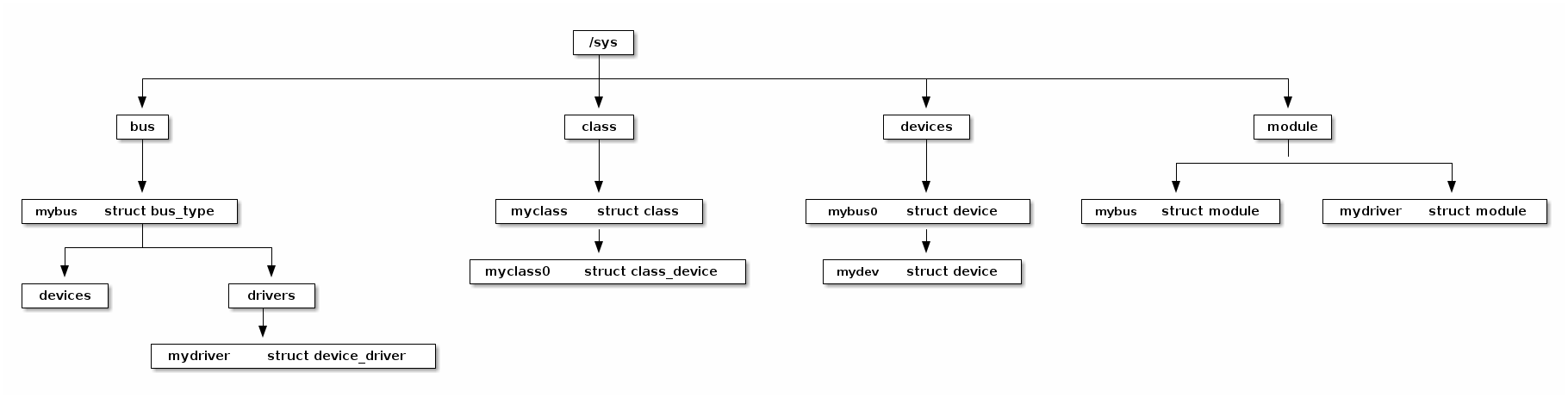
Bones Structures in Linux Devices
Linux Device Model provides a number of structures to ensure the interaction between a hardware device and a device commuter. The whole model is based on kobject structure. Hierarchies are built using this structure and the post-obit structures are implemented:
- struct bus_type
- struct device
- struct device_driver
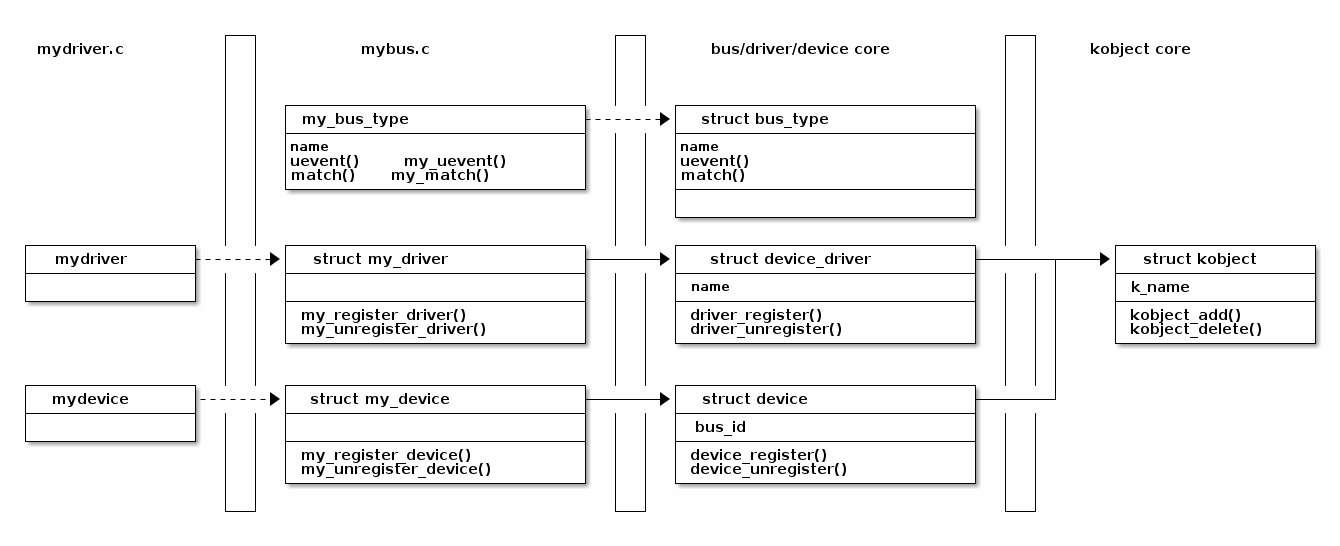
The kobject structure
A kobject construction does non perform a single function. This construction is usually integrated into a larger ane. A kobject structure actually incorporates a ready of features that will exist offered to a higher abstraction object in the Linux Device Model bureaucracy.
For example, the cdev structure has the post-obit definition:
struct cdev { struct kobject kob ; struct module * possessor ; const struct file_operations * ops ; struct list_head list ; dev_t dev ; unsigned int count ; }; Note that this structure includes a kobject construction field.
A kobject structure is divers as follows:
struct kobject { const char * name ; struct list_head entry ; struct kobject * parent ; struct kset * kset ; struct kobj_type * ktype ; struct sysfs_dirent * sd ; struct kref kref ; unsigned int state_initialized : 1 ; unsigned int state_in_sysfs : 1 ; unsigned int state_add_uevent_sent : 1 ; unsigned int state_remove_uevent_sent : 1 ; unsigned int uevent_suppress : 1 ; }; As we tin run into, the kobject structures are in a hierarchy: an object has a parent and holds a kset fellow member, which contains objects on the same level.
Working with the structure involves initializing it with the kobject_init() function. Also in the initialization procedure it is necessary to fix the name of the kobject structure, which will appear in sysfs, using the kobject_set_name() function.
Whatsoever operation on a kobject is done by incrementing its internal counter using kobject_get() , or decrementing if it is no longer used using kobject_put() . Thus, a kobject object will merely be released when its internal counter reaches 0. A method of notifying this is needed and so that the resource associated with the device structure which included the kobject structure are released (for example, cdev). The method is chosen release and is associated with the object via the ktype field ( struct kobj_type ).
The kobject structure is the bones construction of the Linux Device Model. The structures in the higher levels of the model are struct bus_type , struct device and struct device_driver .
Buses
A bus is a communication channel between the processor and an input/output device. To ensure that the model is generic, all input/output devices are connected to the processor via such a bus (even if it tin can be a virtual one without a physical hardware correspondent).
When adding a system bus, it volition appear in the sysfs file system in /sys/bus . As with kobjects, buses can be organized into hierarchies and will exist represented in sysfs.
In the Linux Device Model, a omnibus is represented by the construction struct bus_type :
struct bus_type { const char * proper name ; const char * dev_name ; struct device * dev_root ; struct bus_attribute * bus_attrs ; struct device_attribute * dev_attrs ; struct driver_attribute * drv_attrs ; struct subsys_private * p ; int ( * match )( struct device * dev , struct device_driver * drv ); int ( * uevent )( struct device * dev , struct kobj_uevent_env * env ); int ( * probe )( struct device * dev ); int ( * remove )( struct device * dev ); //... }; It tin can be noticed that a motorbus has a name, lists of default attributes, a number of specific functions, and the driver's individual data. The uevent function (formerly hotplug ) is used with hotplug devices.
Motorcoach operations are the registration, the implementation of the operations described in the struct bus_type structure and the iteration and inspection of the devices connected to the jitney.
A autobus is registered using bus_register() , and unregistered using bus_unregister() .
Implementation example:
#include <linux/device.h> /* mybus.c */ //bus type struct bus_type my_bus_type = { . name = "mybus" , . match = my_match , . uevent = my_uevent , }; static int __init my_bus_init ( void ) { int err ; //... err = bus_register ( & my_bus_type ); if ( err ) return err ; //... } static void __exit my_bus_exit ( void ) { //... bus_unregister ( & my_bus_type ); //... } The functions that will normally be initialized within a bus_type construction are match and uevent :
#include <linux/device.h> #include <linux/string.h> /* mybus.c */ // match devices to drivers; just do a elementary name examination static int my_match ( struct device * dev , struct device_driver * driver ) { return ! strncmp ( dev_name ( dev ), driver -> proper name , strlen ( commuter -> name )); } // respond to hotplug user events; add environs variable DEV_NAME static int my_uevent ( struct device * dev , struct kobj_uevent_env * env ) { add_uevent_var ( env , "DEV_NAME=%s" , dev_name ( dev )); return 0 ; } The match function is used when a new device or a new driver is added to the jitney. Its role is to make a comparison between the device ID and the driver ID. The uevent role is chosen before generating a hotplug in user-infinite and has the role of adding environment variables.
Other possible operations on a passenger vehicle are iterating over the drivers or devices fastened to it. Although we tin non directly access them (lists of drivers and devices being stored in the private data of the driver, the subsys_private *p field), these tin can exist iterated using the bus_for_each_dev and bus_for_each_drv macros.
The Linux Device Model interface allows you to create attributes for the associated objects. These attributes will accept a corresponding file in the bus subdirectory in sysfs. The attributes associated with a bus are described by the bus_attribute structure :
struct bus_attribute { struct attribute attr ; ssize_t ( * show )( struct bus_type * , char * buf ); ssize_t ( * store )( struct bus_type * , const char * buf , size_t count ); }; Typically, an attribute is defined by the BUS_ATTR macro. The bus_create_file() and bus_remove_file() functions can be used to add/delete an aspect within the autobus structure.
An example of defining an attribute for my_bus is shown below:
/* mybus.c */ #ascertain MY_BUS_DESCR "SO2 rules forever" // export a simple bus attribute static ssize_t my_show_bus_descr ( struct bus_type * bus , char * buf ) { return snprintf ( buf , PAGE_SIZE , "%s \northward " , MY_BUS_DESCR ); } /* * ascertain attribute - attribute name is descr; * full name is bus_attr_descr; * sysfs entry should be /sys/jitney/mybus/descr */ BUS_ATTR ( descr , 0444 , my_show_bus_descr , Naught ); // specify attribute - in module init function static int __init my_bus_init ( void ) { int err ; //... err = bus_create_file ( & my_bus_type , & bus_attr_descr ); if ( err ) { /* handle error */ } //... } static void __exit my_bus_exit ( void ) { //... bus_remove_file ( & my_bus_type , & bus_attr_descr ); //... } The omnibus is represented past both a bus_type object and a device object, as we will come across subsequently (the bus is also a device).
Devices
Any device in the system has a struct device structure associated with information technology. Devices are discovered by different kernel methods (hotplug, device drivers, system initialization) and are registered in the system. Each device present in the kernel has an entry in /sys/devices .
At the everyman level, a device in Linux Device Model is represented by a struct device structure:
struct device { //... struct device * parent ; struct device_private * p ; struct kobject kobj ; const char * init_name ; /* initial proper name of the device */ //... struct bus_type * bus ; /* blazon of double-decker device is on */ struct device_driver * driver ; /* which driver has allocated this device */ //... void ( * release )( struct device * dev ); }; Construction fields include the parent device that is normally a controller, the associated kobject , the motorbus information technology is connected to, the device commuter, and a part called when the device counter reaches 0 ( release ).
As usual, nosotros have the registration/unregistration functions device_register() and device_unregister() .
To piece of work with attributes, we have structure struct device_attribute , the macro DEVICE_ATTR for definition, and the functions device_create_file() and device_remove_file() for adding/removing the attribute to/from the device.
One important matter to note is that the struct device structure is normally non used directly, but it is added to another construction. For case:
// my device type struct my_device { char * name ; struct my_driver * commuter ; struct device dev ; }; Typically, a motorcoach commuter will export functions to add or remove such a device, as shown below:
/* mybus.c */ /* BUS DEVICE (parent) */ // parent device release static void my_bus_device_release ( struct device * dev ) { } // parent device static struct device my_bus_device = { . init_name = "mybus0" , . release = my_bus_device_release }; /* DEVICE */ /* * as we are non using the reference count, we employ a no-op * release role */ static void my_dev_release ( struct device * dev ) { } int my_register_device ( struct my_device * mydev ) { mydev -> dev . bus = & my_bus_type ; mydev -> dev . parent = & my_bus_device ; mydev -> dev . release = my_dev_release ; dev_set_name ( & mydev -> dev , mydev -> proper name ); return device_register ( & mydev -> dev ); } void my_unregister_device ( struct my_device * mydev ) { device_unregister ( & mydev -> dev ); } /* export annals/unregister device functions */ EXPORT_SYMBOL ( my_register_device ); EXPORT_SYMBOL ( my_unregister_device ); As seen, the functions my_register_device and my_unregister_device , used to add/remove a device to/from a bus, are defined in the same file where the bus is defined. Device structures are non initialized; they volition be initialized when the devices are discovered by the organization (by hotplug or straight registration from commuter) and the office my_register_device will be called to add a device to the passenger vehicle.
To use the charabanc defined to a higher place in the driver implementation, we must define a construction of blazon my_device , initialize it and register information technology using the function exported by the motorbus ( my_register_device ).
/* mydriver.c */ static struct my_device mydev ; char devname [ NAME_SIZE ]; //... //register int err ; sprintf ( devname , "mydev0" ); mydev . name = devname ; mydev . driver = & mydriver ; dev_set_drvdata ( & mydev . dev , & mydev ); err = my_register_device ( & mydev ); if ( err < 0 ) { /*handle error */ } //.. //unregister my_unregister_device ( & mydev ); Drivers
Linux Device Model is used to allow uncomplicated association between arrangement devices and drivers. Drivers tin can export information independent of the physical device.
In sysfs, driver information has no unmarried subdirectory associated; They can be found in the directory structure in different places: the loaded module is in /sys/module , in /sys/devices yous can find the driver associated with each device, in /sys/grade the drivers belonging to a course, in /sys/bus the drivers associated to each bus.
A device driver is identified by the construction struct device_driver :
struct device_driver { const char * name ; struct bus_type * autobus ; struct driver_private * p ; struct module * possessor ; const char * mod_name ; /* used for built-in modules */ int ( * probe ) ( struct device * dev ); int ( * remove ) ( struct device * dev ); void ( * shutdown ) ( struct device * dev ); int ( * suspend ) ( struct device * dev , pm_message_t state ); int ( * resume ) ( struct device * dev ); }; Among the structure fields nosotros find the name of the driver (appears in sysfs ), the bus with which the driver works, and functions called at various times in a device'southward operation.
As before, we have the functions driver_register() and driver_unregister() to register/unregister a commuter.
To piece of work with attributes, we have the struct driver_attribute structure, the macro DRIVER_ATTR for definition, and the functions driver_create_file() and driver_remove_file() functions for calculation the attribute to the device.
As with devices, the construction struct device_driver is usually incorporated into another structure specific to a particular bus (PCI, USB, etc.):
/* mybus.c */ // my commuter blazon struct my_driver { struct module * module ; struct device_driver driver ; }; #ascertain to_my_driver(drv) container_of(drv, struct my_driver, commuter); int my_register_driver ( struct my_driver * driver ) { int err ; driver -> commuter . bus = & my_bus_type ; err = driver_register ( & driver -> driver ); if ( err ) return err ; return 0 ; } void my_unregister_driver ( struct my_driver * driver ) { driver_unregister ( & commuter -> commuter ); } /* export register/unregister driver functions */ EXPORT_SYMBOL ( my_register_driver ); EXPORT_SYMBOL ( my_unregister_driver ); Commuter registration/unregistration operations are exported for use in other modules.
As for devices, the operations for drivers are defined when the bus is initialized and they are exported to be used by drivers. When implementing a driver that works with devices attached to the bus, we volition call the functions my_register_driver and my_unregister_driver to associate with the bus.
To apply the functions (in the driver implementation), we must declare a structure of blazon my_driver , initialize it and register using the function exported by the bus.
/* mydriver.c */ static struct my_driver mydriver = { . module = THIS_MODULE , . driver = { . proper name = "mydriver" , }, }; //... //register int err ; err = my_register_driver ( & mydriver ); if ( err < 0 ) { /*handle error */ } //.. //unregister my_unregister_driver ( & mydriver ); Classes
A class is a high-level view of the Linux Device Model, which abstracts implementation details. For case, in that location are drivers for SCSI and ATA drivers, but all belong to the grade of disks. Classes provide a grouping of devices based on functionality, not how they are connected or how they work. Classes have a correspondent in /sys/classes .
There are two main structures that describe the classes: struct form and struct device . The class construction describes a generic class, while the structure struct device describes a class associated with a device. In that location are functions for initializing/deinitiating and adding attributes for each of these, described in include/linux/device.h .
The advantage of using classes is that the udev programme in userspace, which we will discuss later, allows the automatic creation of devices in the /dev directory based on class data.
For this reason, we volition continue to present a pocket-size prepare of functions that work with classes to simplify the use of the plug and play mechanism.
A generic grade is described by structure form structure:
struct class { const char * name ; struct module * owner ; struct kobject * dev_kobj ; struct subsys_private * p ; struct class_attribute * class_attrs ; struct class_device_attribute * class_dev_attrs ; struct device_attribute * dev_attrs ; int ( * dev_uevent )( struct device * dev , struct kobj_uevent_env * env ); void ( * class_release )( struct course * grade ); void ( * dev_release )( struct device * dev ); //... }; The class_register() and class_unregister() functions can be used for initialization/deinitialization.
static struct class my_class = { . proper name = "myclass" , }; static int __init my_init ( void ) { int err ; //... err = class_register ( & my_class ); if ( err < 0 ) { /* handle error */ } //... } static void __exit my_cleanup ( void ) { //... class_unregister ( & my_class ); //... } A class associated with a device is described by the struct device construction. The device_create() and device_destroy() functions tin can exist used for initialization/deinitialization. The device_create() function initializes the device structure, and assigns the generic class structure and the device received as a parameter to it; In addition, information technology volition create an aspect of the class, dev , which contains the minor and major of the device ( pocket-sized:major ). Thus, udev utility in usermode can read the necessary data from this aspect file to create a node in the /dev directory by calling makenod .
An example of initialization:
struct device * my_classdev ; struct cdev cdev ; struct device dev ; //init class for device cdev.dev my_classdev = device_create ( & my_class , NULL , cdev . dev , & dev , "myclass0" ); //destroy course for device cdev.dev device_destroy ( & my_class , cdev . dev ); When a new device is discovered, a grade and a node will be assigned to it and a node will be created in the /dev directory. For the example above, the node /dev/myclass0 will be generated.
Hotplug
Hotplug describes the mechanism for adding or removing a device from the organization while it is running without having to reboot the system.
A hotplug result is a notification from the kernel to the user-space when something changes in the organization configuration. These events are generated when creating or removing a kobject from the kernel. Since these objects are the footing of the Linux Device Model, being included in all structures ( struct bus_type , struct device , struct device_driver , struct class , etc.), a hotplug event will exist generated when whatever of these structures is created or removed ( uevent ).
When a device is discovered in the system, an event is generated. Depending on the betoken where it resides in Linux Device Model, the functions corresponding to the event will be called (usually, the uevent function associated to the charabanc or the grade). Using these functions, the commuter has the ability to prepare system variables for the user-space. The generated result so reaches the user-infinite. Here is the udev utility that captures these events. At that place are configuration files for this utility in the /etc/udev/ directory. Different rules can be specified to capture only sure events and perform certain deportment, depending on the system variables set in the kernel or in uevent functions.
An important consequence is that in this fashion the plug and play mechanism tin can exist achieved; with the help of udev and the classes (described above), entries in the /dev/ directories can exist automatically created for devices, and using udev drivers can exist automatically loaded for a device.
Rules for udev are located /etc/udev/rules.d . Whatever file that ends with .rules in this directory will exist parsed when an event occurs. For more details on how to write rules in these files see Writing udev rules. For testing, there are utilities such equally udevmonitor , udevinfo and udevtest .
For a quick instance, consider the situation where we want to automatically load a driver for a device when an effect occurs. We tin create a new file /etc/udev/rules.d/myrules.rules, we will have the post-obit line:
SUBSYSTEM == "pnp", ATTRS{id}== "PNP0400", RUN += "/sbin/insmod /root/mydriver.ko" This will cull from the events generated only those belonging to the pnp subsystem (continued to PNP bus) and having an id attribute with the value PNP0400 .
When this dominion will be constitute, the command specified under RUN will exist executed to insert the advisable driver in the kernel.
Plug and Play
As noted higher up, in Linux Device Model all devices are connected by a double-decker, even if information technology has a respective physical hardware or it is virtual.
The kernel already has implemented virtually buses using a bus_type structure and functions to register/unregister drivers and devices. To implement a driver, we must first decide the bus to which the supported devices are connected and utilise the structures and functions exported by this motorbus. The chief buses are PCI , USB , PNP , IDE , SCSI , platform , ACPI , etc.
PNP autobus
The plug and play mechanism provides a means of detecting and setting the resources for legacy driver that may not be configured or otherwise. All plug and play drivers, protocols, services are based on Plug and Play level. It is responsible for the exchange of information between drivers and protocols. The following protocols are available:
PNPBIOS- used for systems such every bit serial and parallel portsISAPNP- offers support for the ISA charabancACPI- offering, among other things, information almost system-level devices
The kernel contains a bus, called pnp_bus , that is used for connecting past many drivers. The implementation and working with the bus follow the Linux Device Model and is very like to what we discussed above.
The principal functions and structures exported by the bus, which can be used by drivers, are:
struct pnp_driver- driver blazon associated to the coachpnp_register_driver()- part used to register a PNP driver in the organizationpnp_unregister_driver()- function used to unregister a PNP driver from the system
As noted in previous sections, the bus has a office called match used to associate the devices with the appropriate drivers. For example, when discovering a new device, a driver which meets the condition given by the match role regarding to the new device. Normally, this condition is a comparation of IDs (commuter id and device id). A common arroyo is using a static table in each driver, which holds information about the devices supported by the driver, which will exist used past the bus when verifying the status. For example, for a parallel port device we have the table parport_pc_pnp_tbl :
static const struct pnp_device_id parport_pc_pnp_tbl [] = { /* Standard LPT Printer Port */ {. id = "PNP0400" , . driver_data = 0 }, /* ECP Printer Port */ {. id = "PNP0401" , . driver_data = 0 }, }; MODULE_DEVICE_TABLE ( pnp , parport_pc_pnp_tbl ); Each driver declares and initializes a construction pnp_driver , such as parport_pc_pnp_driver :
static int parport_pc_pnp_probe ( struct pnp_dev * dev , const struct pnp_id * card_id , const struct pnp_id * dev_id ); static void parport_pc_pnp_remove ( struct pnp_dev * dev ); static struct pnp_driver parport_pc_pnp_driver = { . proper noun = "parport_pc" , . id_table = parport_pc_pnp_tbl , . probe = parport_pc_pnp_probe , . remove = parport_pc_pnp_remove , }; Nosotros tin can detect that the structure has as fields a pointer to the table declared higher up and two functions, which are chosen when a new device is detected and when it is removed from the system. As all the structures presented to a higher place, the driver must exist registered to the system:
static int __init parport_pc_init ( void ) { err = pnp_register_driver ( & parport_pc_pnp_driver ); if ( err < 0 ) { /* handle error */ } } static void __exit parport_pc_exit ( void ) { pnp_unregister_driver ( & parport_pc_pnp_driver ); } PNP operations
So far we accept discussed the Linux Device Model and its API. To implement a plug and play commuter, nosotros must respect the Linux Device Model model.
Most often, calculation a bus in the kernel is not necessary, as almost of the existing buses are already implemented (PCI, USB, etc.). Thus, we must first identify the bus to which the device is attached. In the examples below, we volition consider that this motorbus is bus PNP and we will utilise the structures and functions described above.
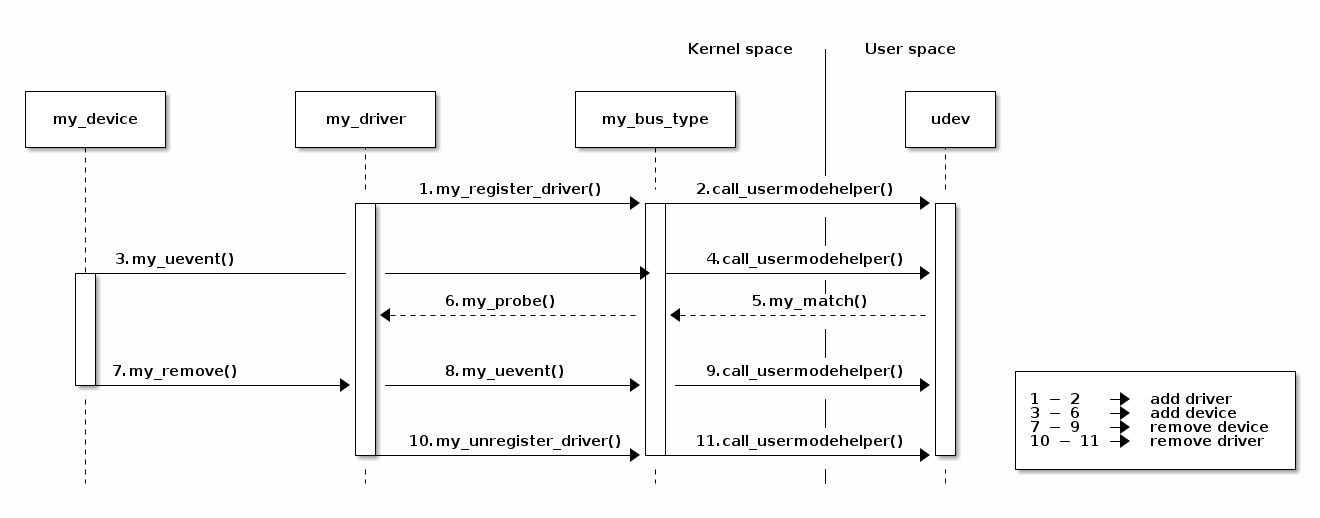
Adding a driver
In improver to the usual operations, a commuter must follow the Linux Device Model. Thus, it will exist registered in the system using the functions provided past the bus for this purpose. Usually, the coach provides a particular driver structure containing a struct device_driver structure, that the driver must initialize and register using a function *_register_driver . For case, for the PNP bus, the driver must declare and initialize a structure of type struct pnp_driver and annals information technology using pnp_register_drvier :
static struct pnp_driver my_pnp_driver = { . name = "mydriver" , . id_table = my_pnp_tbl , . probe = my_pnp_probe , . remove = my_pnp_remove , }; static int __init my_init ( void ) { err = pnp_register_driver ( & my_pnp_driver ); } Unlike legacy drivers, plug and play drivers don't annals devices at initialization in the init office ( my_init in the instance in a higher place) using register_device() .
As described above, each autobus has a match function which is called when a new device is detected in the system to determine the associated driver. Thus, at that place must be a fashion for each driver to export information about the devices information technology supports, to allow this check to pass and have its functions further called. In the examples presented in this lab, the match function does a uncomplicated comparison between the device proper noun and the commuter proper name. Most drivers use a table containing information devices and store a pointer to this tabular array in the commuter structure. For case, a commuter associated to a PNP bus defines a table of type struct pnp_device_id and initializes the field id_table from the structure pnp_driver my_pnp_driver with a pointer to information technology:
static const struct pnp_device_id my_pnp_tbl [] = { /* Standard LPT Printer Port */ {. id = "PNP0400" , . driver_data = 0 }, /* ECP Printer Port */ {. id = "PNP0401" , . driver_data = 0 }, { } }; MODULE_DEVICE_TABLE ( pnp , my_pnp_tbl ); static struct pnp_driver my_pnp_driver = { //... . id_table = my_pnp_tbl , //... }; In the example above, the driver supports multiple parallel port devices, defined in the table my_pnp_tbl . This data is used by the bus in the match_device function. When calculation a driver, the bus driver volition be associated to it and new entires in sysfs will exist created based on the driver proper name. Then the bus match part will be called for every supported device, to acquaintance the driver with any continued device that it supports.
Removing a driver
To remove a driver from the kernel, in addition to operations required for a legacy driver, we must unregister the device_driver structure. For a driver associated with the PNP jitney, we must unregister the pnp_driver structure using the pnp_unregister_driver() office:
static struct pnp_driver my_pnp_driver ; static void __exit my_exit ( void ) { pnp_unregister_driver ( & my_pnp_driver ); } Unlike legacy drivers, plug and play drivers don't unregister devices in the module unload function ( my_exit ). When a driver is removed, all the references to information technology will exist removed for all the devices it supports, and entries from sysfs will also be removed.
Adding a new device
Equally we saw to a higher place, plug and play drivers practise not register devices at initialization. This operation volition have place in the probe function, which is called when a new device is detected. A device attached to the PNP motorcoach will be added to the arrangement by the function probe from the pnp_driver construction:
static int my_pnp_probe ( struct pnp_dev * dev , const struct pnp_id * card_id , const struct pnp_id * dev_id ) { int err , iobase , nr_ports , irq ; //get irq & ports if ( pnp_irq_valid ( dev , 0 )) irq = pnp_irq ( dev , 0 ); if ( pnp_port_valid ( dev , 0 )) { iobase = pnp_port_start ( dev , 0 ); } else return - ENODEV ; nr_ports = pnp_port_len ( dev , 0 ); /* register device dev */ } static struct pnp_driver my_pnp_driver = { //... . probe = my_pnp_probe , //... }; Upon detection of a device in the kernel (at boot or by the insertion of the device through hotplug ), an interrupt is generated and reaches the bus driver. The device is registered using the function device_register() and it is attached to the bus. A phone call to the user space will likewise be generated, and the event can be treated by udev . Then, the listing of drivers associated with the bus is iterated and the match function is chosen for each of them. The match part tries to find a driver for the new device. Afterward a suitable commuter is found for the device, the probe office of the driver is called. If the part ends successfully, the device is added to the commuter'southward list of devices and new entries are created in sysfs based on the device proper noun.
Removing a device
As we saw above, the plug and play drivers don't unregister devices when the driver is unloaded. This functioning is done in the remove function, which is called when a device is removed from the system. In instance of a device attached to the PNP motorcoach, the unregister will exist done in the remove function specified in the pnp_driver structure:
static void my_pnp_remove ( struct pnp_dev * dev ) { /* unregister device dev */ } static struct pnp_driver my_pnp_driver = { //... . remove = my_pnp_remove , }; Every bit seen in the case above, when the removal of a device is detected, the my_pnp_remove part is called. A user-space telephone call is likewise generated, which can be detected by udev , and entries are removed from sysfs .
Exercises
Important
To solve exercises, you demand to perform these steps:
- set up skeletons from templates
- build modules
- re-create modules to the VM
- start the VM and test the module in the VM.
The electric current lab proper noun is device_model. See the exercises for the chore name.
The skeleton lawmaking is generated from full source examples located in tools/labs/templates . To solve the tasks, showtime by generating the skeleton lawmaking for a complete lab:
tools/labs $ make make clean tools/labs $ LABS =<lab proper noun> brand skels You lot tin too generate the skeleton for a single job, using
tools/labs $ LABS =<lab name>/<job proper noun> brand skels Once the skeleton drivers are generated, build the source:
And then, copy the modules and start the VM:
tools/labs $ brand copy tools/labs $ brand boot The modules are placed in /domicile/root/skels/device_model/<task_name>.
Alternatively, nosotros can copy files via scp, in order to avoid restarting the VM. For additional details about connecting to the VM via the network, please check Connecting to the Virtual Motorcar.
Review the Exercises department for more detailed data.
Warning
Earlier starting the exercises or generating the skeletons, please run git pull within the Linux repo, to make certain you take the latest version of the exercises.
If you accept local changes, the pull command will fail. Check for local changes using git status . If you want to go along them, run git stash before pull and git stash popular later on. To discard the changes, run git reset --difficult master .
If you already generated the skeleton before git pull you will need to generate information technology again.
0. Intro
Discover the definitions of the post-obit symbols in the Linux kernel:
- functions
dev_name,dev_set_name.- functions
pnp_device_probe,pnp_bus_match,pnp_register_driverand thepnp_bus_typevariable.
1. Bus implementation
Clarify the contents of the bex.c , a module that implements a bus driver. Follow the comments marked with TODO 1 and implement the missing functionality: register the passenger vehicle commuter and add a new device named root with type none and version 1.
Hint
The register and unregister must exist done using bus_register() and bus_unregister() .
Load the module and verify that the passenger vehicle is visible in /sys/bus . Verify that the device is visible in /sys/bus/bex/devices .
Remove the module and notice that the sysfs entries are removed.
2. Add together type and version device attributes
Add together ii read-just device attributes, type and version . Follow the TODO 2 markings.
Hint
Y'all will demand to add the 2 attributes in the structure bex_dev_attrs , every bit follows:
&dev_attr_<insert-attribute-type-here>.attr,
Hint
A possible implementation for the show function is the following:
static ssize_t type_show ( struct device * dev , struct device_attribute * attr , char * buf ) { struct bex_device * bex_dev = to_bex_device ( dev ); return sprintf ( buf , "%due south \n " , bex_dev -> blazon ); } DEVICE_ATTR_RO ( type ); Observe that two new attributes are visible in /sys/motorbus/bex/devices/root. Check the contents of these attributes.
three. Add del and add autobus attributes
Add ii write-only bus attributes, del and add . del expects the name of a device to delete, while add expects the name, type and version to create a new device. Follow the TODO 3 markings and review Buses.
Hint
Use sscanf() to parse the input from sysfs and bex_del_dev() and bex_add_dev() to delete and create a new device.
An example for the store function is the following:
static ssize_t add_store ( struct bus_type * bt , const char * buf , size_t count ) { char name [ 32 ]; int ret ; ret = sscanf ( buf , "%31s" , name ); if ( ret != 1 ) render - EINVAL ; ... } BUS_ATTR ( add , S_IWUSR , NULL , add_store ); Hint
The shop functions should return 0 if bex_add_dev / bex_del_dev fail and count otherwise.
Create a new device and observe that is visible in /sys/bus/devices . Delete it and find it disapears from sysfs .
Hint
Use repeat to write into the bus attributes:
$ repeat "name type 1" > /sys/bus/bex/add $ echo "proper noun" > /sys/motorbus/bex/del 4. Register the bex misc driver
Alter bex-misc.c so that it registers the commuter with the bex omnibus. Insert the bmx_misc.ko module and create a new bex device from sysfs with the name "test", type "misc", version 2. Follow the TODO 4 markings.
Discover that the driver is visible in /sys/coach/bex/drivers .
Why isn't the probe function called?
Hint
Notice that the bus match function in bex.c is non implemented.
Implement the coach matching role in bex.c. Follow the TODO 5 markings. Try over again to create a new bex device and detect that this fourth dimension the probe function from the bex_misc commuter is called.
five. Register misc device in the bex_misc probe function
Modify bex_misc.c to decline probing if version > 1 . Also, annals the divers misc device in bex_misc_probe and deregister it in bex_misc_remove . Follow the TODO 6 markings.
Hint
Use misc_register() and misc_deregister() .
Create a new device with the name "test", type "misc" and version 2 and observe that the probe fails. Create a new device with the proper name "test2", type "misc" and version 1 and notice that the probe is successful.
Audit /sys/bus/bex/devices/test2 and observe that nosotros have a new entry. Identify the major and minor for the misc device, create a character device file and try to read and write from the misc device buffer.
Hint
The major and small should be visible in the dev aspect of the misc device
6. Monitor uevent notifications
Employ the udevadm monitor command and observe what happens when:
- the
bex.koandbex_misc.komodules are inserted - a new device with the blazon "type" is created
- a new device with the blazon "misc" and version two is created
- a new device with the type "misc" and version 1 is created
- all of the above are removed

Where Does Device Driver Load Registers,
Source: https://linux-kernel-labs.github.io/refs/heads/master/labs/device_model.html
Posted by: samstume1946.blogspot.com
0 Response to "Where Does Device Driver Load Registers"
Post a Comment